


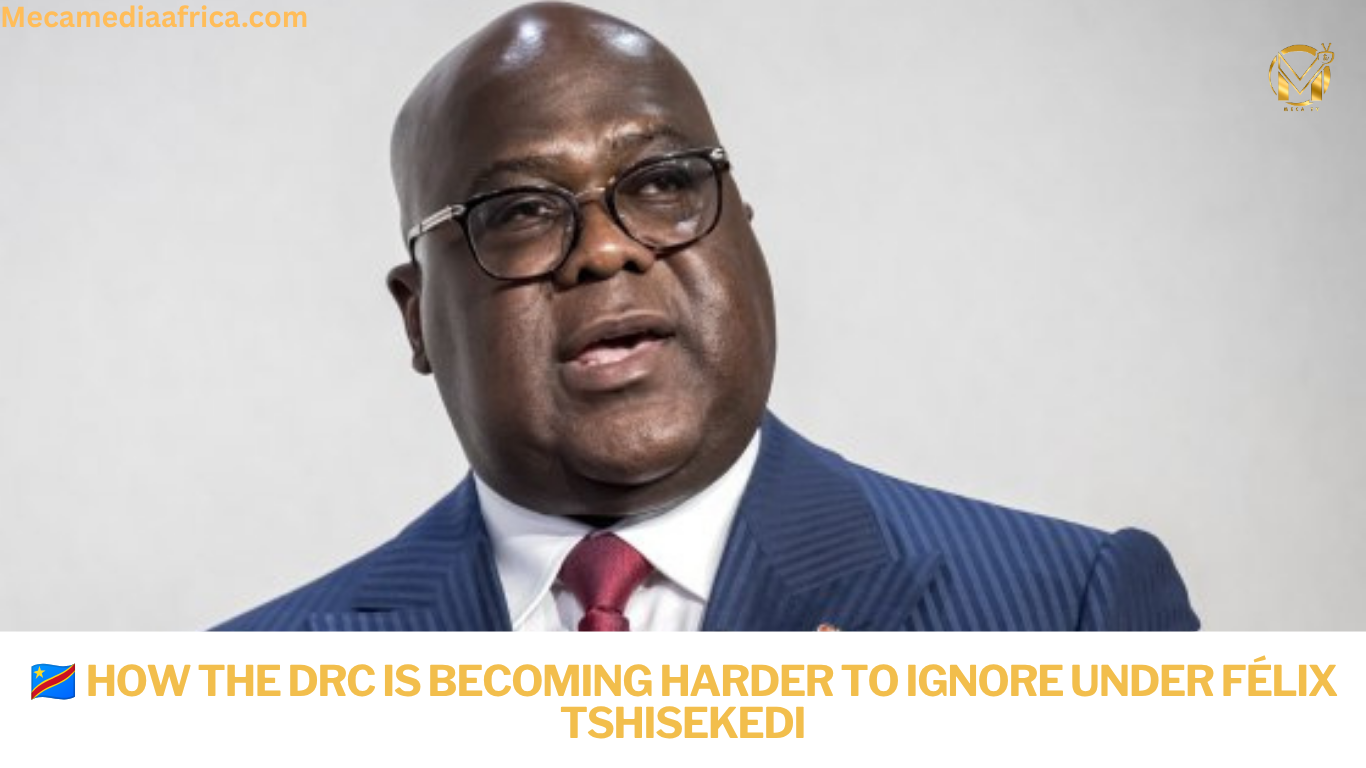
For decades, the Democratic Republic of the Congo was often described mainly through the actions of others: foreign intervention, armed rebellion, mineral exploitation, displacement and institutional weakness.
Under President Félix Tshisekedi, however, a different pattern is emerging.
The central question is no longer only what foreign powers, armed groups and multinational companies do inside Congo. Increasingly, it is also what happens when Congolese institutions begin forcing others to respond to decisions made in Kinshasa.
From cross-border judicial cooperation and international litigation to mineral negotiations, infrastructure concessions, sanctions diplomacy and strategic partnerships, the DRC is gradually expanding the tools available to defend its interests.
That does not mean Congo has solved its security, governance or development challenges. Large parts of eastern DRC remain unstable, major infrastructure projects are unfinished and millions of Congolese still lack reliable electricity, transport and digital access.
But the country is becoming more difficult to ignore, bypass or treat simply as a source of raw materials.
1. Congolese Justice Begins Reaching Beyond National Borders
A striking example came in late August 2026, when Tanzanian authorities arrested Congolese social-media personality Denise Mukendi Dusauchoy.
According to the Congolese Ministry of Justice, the arrest followed a warrant issued by Congolese judicial authorities through international cooperation mechanisms.
She was subsequently transferred to Kinshasa, where prosecutors placed her under a provisional arrest warrant.
Government spokesperson Patrick Muyaya summarized the political message with a warning:
“Wherever you are in the world, justice will reach you.”
But the legal safeguards remain essential.
An arrest is not a conviction, and the allegations remain subject to judicial determination. Dusauchoy retains the presumption of innocence and the right to challenge both the accusations and the procedures surrounding her transfer.
Still, the case demonstrated something important: a judicial decision taken in Congo produced concrete action by another sovereign state.
That is one basic measure of institutional reach.
2. From a Country Acted Upon to a Country That Acts
Modern Congolese history has given the country many reasons to focus on sovereignty.
From regional wars following the 1994 Rwandan genocide to recurring rebellions in eastern Congo, the DRC has often been treated internationally as a territory where neighboring armies, armed groups and economic networks operate.
Kinshasa is increasingly attempting to change that dynamic through formal institutions.
The DRC brought an interstate case against Rwanda before the African Court on Human and Peoples’ Rights, turning allegations of sovereignty violations into a continental legal process.
In 2025, the court rejected Rwanda’s preliminary objections, allowing the case to continue toward consideration of the merits.
That was not a judgment finding Rwanda responsible. But it demonstrated that Congo had successfully kept its claims before an international judicial institution.
The DRC was also elected to serve as a non-permanent member of the United Nations Security Council for 2026–2027, receiving 183 votes.
That gives Kinshasa a direct seat inside one of the world’s most important institutions dealing with international peace and security.
3. Eastern Congo Becomes a Major International Diplomatic File
One of Kinshasa’s most important diplomatic achievements came with UN Security Council Resolution 2773, adopted unanimously in February 2025.
The resolution addressed the M23 conflict, reaffirmed Congolese territorial integrity and demanded actions related to armed groups and foreign military involvement.
For Kinshasa, the importance of the resolution was that the eastern DRC conflict was no longer framed internationally merely as another domestic rebellion.
It became a formal international peace-and-security issue involving borders, foreign military presence, mineral trafficking and state authority.
The United States, European Union and United Kingdom also adopted various diplomatic and sanctions measures connected to the conflict.
Those actions did not end the war.
But they changed the diplomatic environment by attaching names, institutions and possible consequences to allegations that Congolese authorities had raised for years.
4. Washington and Doha Become Central to Congo’s Peace Strategy
The United States helped facilitate a peace agreement between the DRC and Rwanda in June 2025.
A separate diplomatic track in Doha brought the Congolese government and AFC/M23 representatives into direct negotiations under Qatari mediation.
By 2026, those processes had produced ceasefire-monitoring structures and additional mechanisms for negotiations.
However, fighting and ceasefire violations continued.
The key achievement therefore is not that peace has already been secured.
Rather, Kinshasa succeeded in moving the conflict into multiple international frameworks where external governments and institutions are expected to participate in implementation and verification.
5. Congo’s Minerals Become Strategic Negotiating Assets
The DRC holds an extraordinary position in global mineral supply chains.
According to US Geological Survey estimates, Congo produced around 230,000 tonnes of cobalt in 2025, representing roughly three-quarters of world production.
It also produced approximately 3.2 million tonnes of copper, making it one of the world’s largest copper producers.
Historically, that mineral wealth often benefited foreign companies and regional trading networks more than the Congolese population.
Kinshasa is increasingly attempting to use mineral access as negotiating leverage.
A US–DRC strategic partnership concluded in December 2025 linked critical minerals with issues including infrastructure, security, local processing, industrialization and supply-chain transparency.
The deeper strategy is clear:
Congo does not necessarily want the world to need fewer Congolese minerals. It wants that global demand to generate more value inside Congo.
6. Cobalt Policy Shows Kinshasa Can Influence Global Markets
In 2025, Congo suspended cobalt exports amid oversupply and falling prices.
The government later introduced export quotas for 2026 and 2027.
Because Congo dominates global cobalt production, decisions taken by regulators in Kinshasa can influence expectations across international battery and electric-vehicle markets.
The policy carries risks.
Restrictions can disrupt producers, affect investment decisions and create incentives for smuggling.
But it also demonstrates that Congo is willing to experiment with its considerable market power rather than simply accepting whatever conditions international commodity markets produce.
7. Lithium Adds Another Strategic Mineral
In July 2026, Congo’s mineral certification authority certified initial lithium export lots from Manono.
Lithium is crucial to batteries and the global energy transition.
The development does not mean Congo already possesses a mature lithium industry.
But it gives Congolese public institutions an early role in establishing traceability, certification and regulation around a mineral that could become increasingly important to the national economy.
The long-term challenge will be ensuring that Congo does not repeat the historic pattern of exporting raw strategic minerals while importing expensive finished products.
8. The Lobito Corridor Could Change Congo’s Economic Geography
The Lobito Corridor is becoming one of the most important infrastructure projects affecting the DRC.
The route connects mineral-producing areas in Congo and Zambia to Angola’s Atlantic coast.
In August 2026, Congo signed a concession with Mota-Engil Africa covering the financing, rehabilitation, modernization and operation of the approximately 1,004.5-kilometre Dilolo–Sakania railway.
The announced investment estimate was approximately $1.258 billion.
If successfully implemented, the project could give Congo a stronger Atlantic export route while reducing dependence on older transport corridors.
The strategic benefit is not simply another railway.
It is optionality.
A country with several competitive trade routes can negotiate freight costs, investment conditions and market access more effectively than one dependent on a single bottleneck.
9. Port of Banana Could Give Congo Greater Atlantic Access
Another major infrastructure project is the Port of Banana.
The planned deep-water port is being developed with an initial container-handling capacity of approximately 450,000 TEUs annually.
A functioning modern deep-water port could improve Congo’s direct access to international maritime trade.
But the distinction between announcement and completion remains important.
The project is still being developed, and its ultimate economic value will depend on completion, road and rail connections, operating costs and integration with the wider Congolese economy.
10. Congo Is Building More Digital State Capacity
The transformation is not only about minerals and diplomacy.
In September 2026, transport authorities launched SYGREM, a digital freight-management platform intended to modernize freight documentation, shipment tracking and payments.
The country is also implementing a $400 million World Bank-backed digital transformation programme.
Targets include improved government digital services and telecommunications infrastructure.
Most of these reforms remain works in progress.
Still, they represent an attempt to increase the state’s visibility over economic activity and reduce opportunities for informal systems that historically weakened public revenue.
11. Public Finance Institutions Are Also Changing
The International Monetary Fund reported that the General Directorate of the Treasury and Public Accounting became operational in early 2026.
The government has also been working on reforms involving public expenditure, treasury management and financial accountability.
The IMF estimated DRC economic growth at around 5.7% in 2025, with continued expansion expected in 2026.
Strong GDP growth, however, does not automatically mean broad improvements in living standards.
The larger challenge is ensuring that mineral wealth and economic expansion generate better roads, electricity, education, healthcare and employment for Congolese citizens.
12. Grand Inga Remains One of Congo’s Biggest Long-Term Opportunities
The DRC possesses enormous hydroelectric potential.
The Grand Inga vision could eventually make the country one of Africa’s most important electricity producers.
The World Bank has approved financing for preparatory work, institutions, safeguards and local infrastructure linked to the wider Inga development programme.
However, this financing should not be confused with construction of the entire Grand Inga complex.
The project remains a long-term ambition.
Its significance lies in the possibility of connecting Congo’s mineral and industrial ambitions with abundant electricity generation.
Without reliable power, local processing of copper, cobalt, lithium and other minerals will remain difficult.
13. Congo’s Population Is Also an Economic Asset
With a population exceeding 110 million people, the DRC is not only a mineral producer.
It is potentially one of Africa’s largest consumer markets.
That changes the economic logic of infrastructure.
Railways, electricity networks, digital systems and roads do not have to serve only mineral exports.
If properly designed, they can connect Congolese businesses, farmers and households to a larger national economy.
That could gradually transform infrastructure from a system designed mainly to extract commodities into one supporting domestic production and consumption.
14. Diplomacy Is Becoming More Diversified
The DRC is simultaneously developing relations with the United States, European countries, Angola, Qatar, Israel and African regional organizations.
This approach gives Kinshasa more diplomatic options.
Rather than relying exclusively on one external power, the government can seek security cooperation from one partner, infrastructure investment from another and mediation from another.
President Tshisekedi’s September 2026 visit to Jerusalem illustrated this approach.
His talks with Israeli leaders focused on areas including security, technology, agriculture, energy and investment.
Again, political discussions should not be confused with completed investment projects.
But the engagement demonstrates Kinshasa’s attempt to widen its international partnerships.
15. Tourism and National Image Become Part of Sovereignty
Congo’s international image remains heavily associated with war and humanitarian crisis.
Yet the country also contains some of the world’s most important natural and cultural assets.
Virunga National Park, Kahuzi-Biega, Garamba, Salonga and the Okapi Wildlife Reserve are internationally recognized conservation sites.
Congolese rumba, fashion, visual arts and Kinshasa’s cultural industries also give the country substantial soft power.
The government has increasingly promoted tourism, cultural diplomacy and international sports partnerships under the “R.D. Congo – Coeur d’Afrique” branding.
The challenge remains security and infrastructure.
Marketing cannot substitute for safe roads, reliable airlines, functioning tourism services or protected national parks.
But controlling how a country presents itself internationally is itself an important element of national influence.
16. What Could Be Called the “Tshisekedi Doctrine”
There is no formally declared government policy called the “Tshisekedi Doctrine.”
But several recurring principles can be identified in the current approach.
They include the use of international law to defend sovereignty, diversification of foreign partnerships, linking mineral access to infrastructure and local processing, stronger participation in regional institutions, investment in administrative capacity and an insistence that economic partnerships deliver reciprocal benefits.
The objective appears to be turning Congo’s enormous size, population and natural resources from vulnerabilities into bargaining power.
But implementation remains the decisive test.
Congo’s Transformation Is Not Finished
The DRC still faces enormous challenges.
Armed groups remain active. Parts of eastern Congo remain outside full government control. Infrastructure gaps are severe. Electricity access remains low. Many investment agreements are still at an early stage.
Those realities make it premature to describe Congo as having completed a geopolitical or economic transformation.
What has changed is the number of tools Kinshasa is attempting to use.
A Congolese judicial request can trigger action abroad.
Congolese diplomacy can place regional security disputes before international courts and the UN Security Council.
Congolese mineral policy can affect global commodity markets.
Congolese infrastructure negotiations increasingly involve some of the world’s largest governments, financial institutions and companies.
That is the deeper shift.
🇨🇩 The Democratic Republic of the Congo is not yet the power it wants to become. But it is increasingly building the institutions, partnerships and leverage needed to make decisions taken in Kinshasa matter far beyond Kinshasa.
Key Numbers
112.8 million: Estimated DRC population in 2025
2.35 million km²: Approximate national territory
5.7%: Estimated real GDP growth in 2025
230,000 tonnes: Estimated cobalt mine production in 2025
3.2 million tonnes: Estimated copper production in 2025
1,004.5 km: Dilolo–Sakania railway concession
$1.258 billion: Estimated investment in the rail modernization project
Up to $553 million: US development-finance commitment related to the Angolan Lobito rail and port system
$400 million: DRC Digital Transformation Project financing
$250 million: Initial World Bank financing for Grand Inga preparation
183 votes: DRC’s election result for its 2026–2027 UN Security Council seat
450,000 TEUs: Planned annual first-phase capacity of the Port of Banana
96,600 tonnes: Announced annual cobalt export ceiling for 2026 and 2027
Read more: https://mecamediaafrica.com
✍️ Author: Meca Media

Mangwa mangwa
Mangwa Mangwa is the Founder of MECAMEDIA, a journalist, media professional, and political analyst committed to delivering credible news and meaningful stories from Africa and around the world. His work focuses on politics, leadership, business, community development, and current affairs, with a mission to inform, inspire, and connect communities through responsible journalism.