


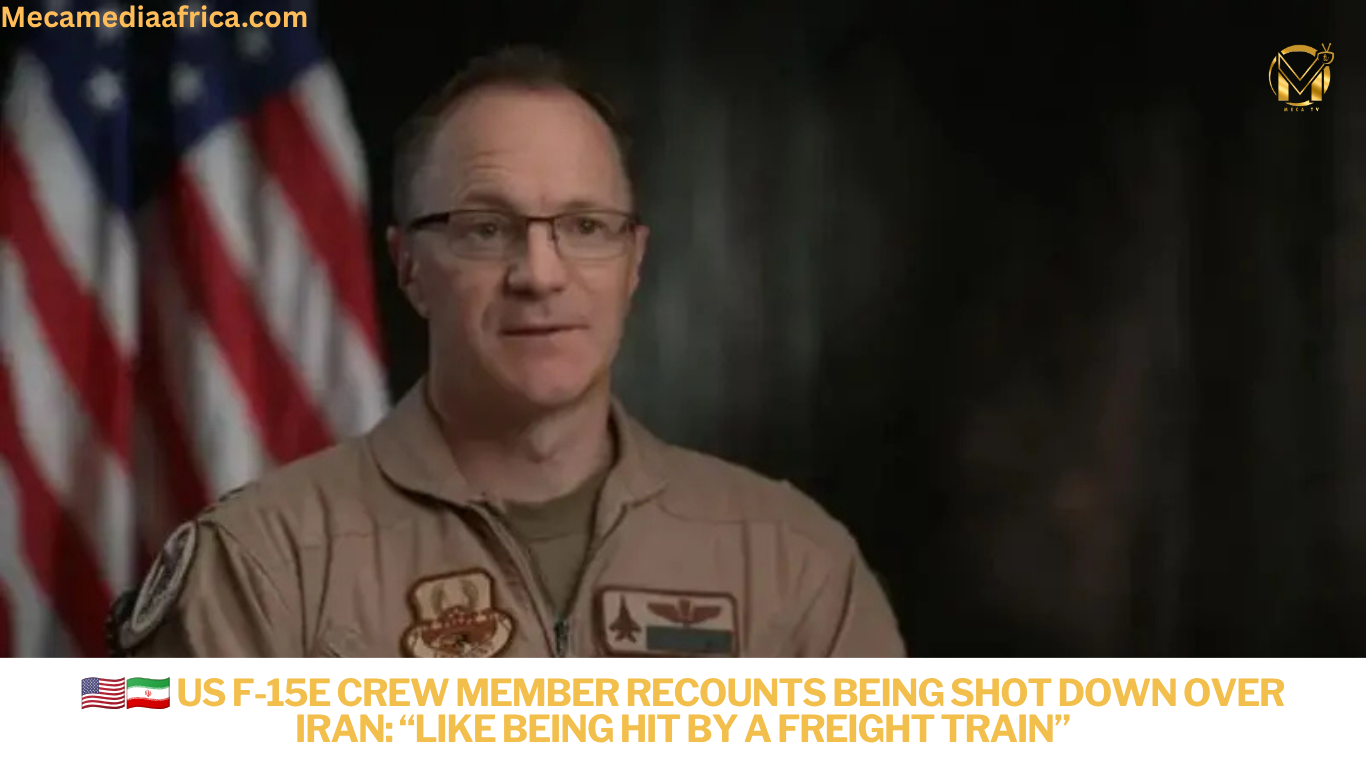
A U.S. Air Force officer whose F-15E Strike Eagle was reportedly shot down over Iran in April has spoken publicly about the incident for the first time, describing the impact on the aircraft as feeling “like being hit by a freight train.”
The officer’s identity has not been publicly disclosed for security reasons. He has instead been identified by the operational designation “Dude 44 Bravo,” or simply “Bravo.”
Bravo served as the weapons systems officer in the rear cockpit of the two-seat F-15E Strike Eagle, while the pilot was identified operationally as “Alpha.”
Speaking to CBS News’ 60 Minutes, Bravo described the moments surrounding the reported loss of the aircraft and the subsequent effort to survive until U.S. forces could reach the crew.
Aircraft Reportedly Went Down Near Isfahan
According to the account, the F-15E went down on the morning of April 3 in mountainous terrain south of Isfahan, a major city in central Iran.
Bravo said the aircraft was struck during its mission and compared the force of the impact to being hit by a freight train.
The crew subsequently had to eject from the damaged fighter.
The F-15E Strike Eagle normally carries two crew members: a pilot in the front cockpit and a weapons systems officer in the rear.
Bravo Describes Difficult Ejection and Landing
Bravo reportedly survived the ejection despite problems involving his parachute and suffered multiple injuries during the incident.
After reaching the ground, his immediate challenge changed from surviving the aircraft loss to avoiding detection and remaining alive until rescuers could reach him.
According to the account provided to 60 Minutes, he attempted to evade Iranian forces while waiting for the U.S. rescue operation.
His account provides a rare personal perspective on what happens after an aircrew is forced to eject over hostile territory.
Around 100 US Personnel Reportedly Involved in Rescue
According to U.S. officials cited in the account, the mission to recover the two aircrew members involved approximately 100 American military personnel entering Iranian territory.
Such a recovery would involve substantial risks because rescue forces must locate and retrieve isolated personnel while operating in potentially hostile territory.
The account says both crew members ultimately survived and were recovered.
Why Was the F-15E Flying Over Iran?
According to Admiral Brad Cooper, commander of the United States Central Command (CENTCOM), the F-15E had been participating in an operation targeting what the U.S. military described as:
“industrial facilities associated with Iran’s drone and missile programs.”
That provides the stated U.S. military purpose for the mission.
The description represents the U.S. military’s account of the target and operation. Any differing Iranian account of the incident should be reported separately rather than presented as part of the U.S. version.
What Is the F-15E Strike Eagle?
The F-15E Strike Eagle is a two-seat fighter aircraft operated by the U.S. Air Force.
Unlike some single-seat fighter variants, the Strike Eagle carries both a pilot and weapons systems officer.
The aircraft was designed for long-range, high-speed missions and can conduct air-to-ground operations while retaining air-to-air combat capability.
Its rear-seat weapons systems officer assists with navigation, sensors, targeting and weapons employment during complex missions.
A Rare Account From Inside a Downed Fighter
What makes Bravo’s account particularly notable is the description of events from inside the aircraft itself.
For fighter crews, ejecting is an emergency procedure that can save their lives but can also cause serious injuries because of the forces involved.
Landing in hostile territory creates an additional challenge: the crew must survive, avoid capture and establish contact with recovery forces.
Bravo’s account describes all three stages — the aircraft being hit, the ejection and the effort to evade forces on the ground before rescue.
Identity Remains Protected
The officer’s full name has not been publicly disclosed in the account because of security considerations.
Using the operational identifiers Alpha and Bravo allows details of the incident to be discussed without revealing the crew members’ identities.
The decision is particularly relevant because the reported mission involved operations inside Iranian territory.
The Mission Highlights the Risks of Air Operations
Beyond the personal survival story, the incident illustrates the dangers faced by military aircrews operating in contested airspace.
Even sophisticated combat aircraft can face threats from surface-to-air missiles and other air-defence systems.
Once an aircraft is lost over hostile territory, the situation can also require a second, potentially dangerous operation to recover its crew.
🇺🇸🇮🇷 For “Dude 44 Bravo,” surviving the loss of the F-15E was only the beginning. After ejecting from the damaged fighter, he still had to survive injuries, evade forces on the ground and wait for an American rescue team to reach him.
Important note: Details concerning the strike, the circumstances in which the aircraft was lost, the rescue mission and its targets should be attributed to the U.S. officials and crew account where independently corroborating information is unavailable.
Official Links:
U.S. Central Command (CENTCOM)
U.S. Air Force — F-15E Strike Eagle
CBS News — 60 Minutes
Bonyeza hapa ili utu follow Meca Media
Follow Meca Media on Facebook:
Meca Media Facebook
Follow Meca Media on WhatsApp:
Meca Media WhatsApp Channel
Read more:
Mecamediaafrica.com
✍️ Author: Mangwa

Ms
Mangwa is the Founder of MECAMEDIA, a journalist, media professional, and political analyst committed to delivering credible news and meaningful stories from Africa and around the world. His work focuses on politics, leadership, business, community development, and current affairs, with a mission to inform, inspire, and connect communities through responsible journalism.