


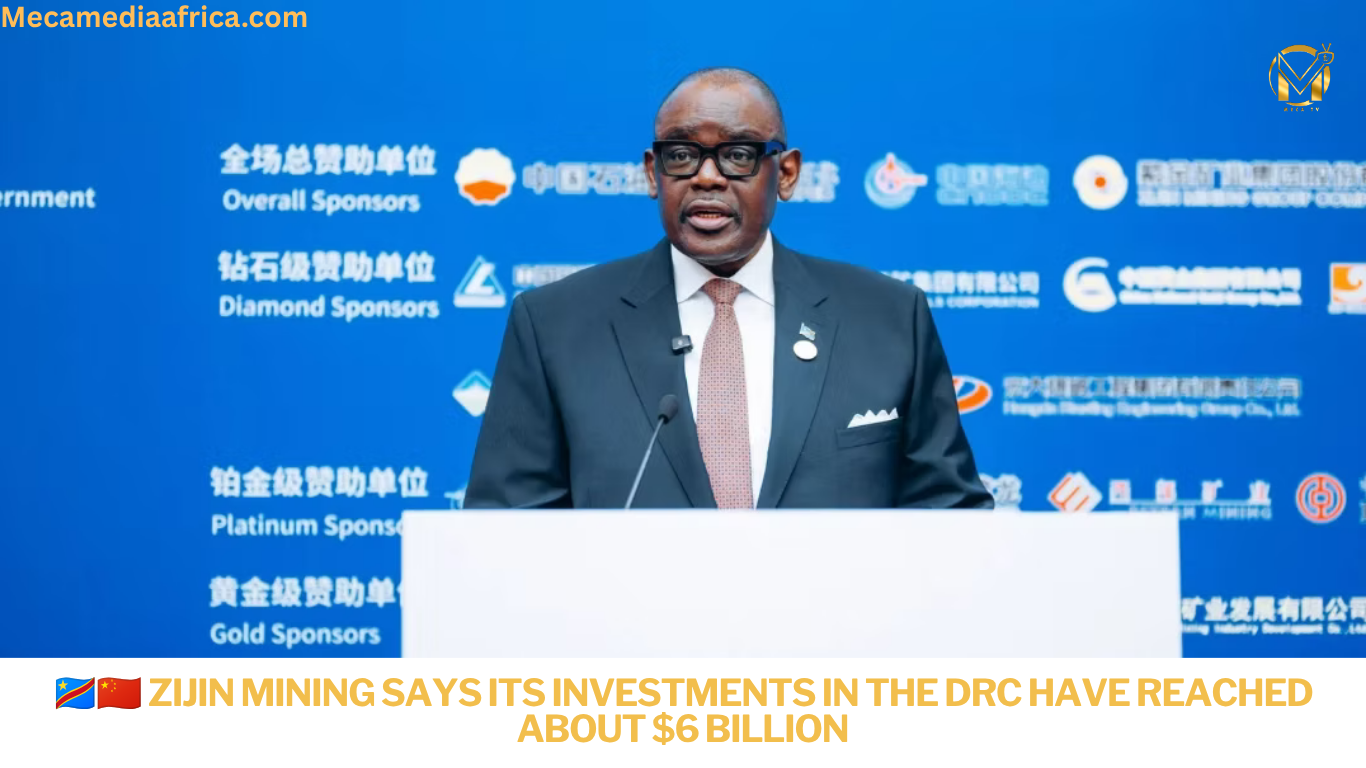
TIANJIN — September 12, 2026 — Chinese mining giant Zijin Mining says its cumulative investments in the Democratic Republic of the Congo have reached approximately US$6 billion, highlighting the growing scale of Chinese capital in Congo’s strategic mineral industry.
The figure was presented during discussions between Zijin representatives and DRC Mines Minister Louis Watum Kabamba on the sidelines of the 28th China Mining Conference and Exhibition in Tianjin.
According to Zoom Eco, discussions reviewed Zijin’s major activities in the DRC, including the COMMUS copper-cobalt operation in Lualaba Province and the Manono lithium project in Tanganyika Province.
Importantly, the $6 billion figure is not a new investment announcement. It represents the approximate cumulative value of Zijin’s existing investments and projects in the country.
$6 Billion Shows the Scale of Chinese Mining Capital in Congo
For Kinshasa, the figure illustrates how deeply international investment has become connected to Congo’s copper, cobalt and emerging lithium industries.
The DRC already occupies a major position in global copper and cobalt supply chains. Development of large lithium deposits could further increase the country’s strategic importance as global demand grows for minerals used in batteries, electrification, digital infrastructure and industrial manufacturing.
The government’s challenge is increasingly about what happens after investment arrives.
Congolese authorities want major mining projects to generate more local employment, mineral processing, infrastructure, technology transfer and opportunities for Congolese businesses.
Louis Watum Pushes for Greater Local Value
During the China Mining conference, Mines Minister Louis Watum Kabamba promoted what the government describes as a more value-focused phase of Congo’s mining strategy.
Rather than measuring success only through production and exports, Kinshasa wants investment to create broader economic benefits inside the country.
A report on the DRC delegation’s activities said discussions with Chinese companies including Zijin and CREC Resources focused on existing projects and ways to establish more durable cooperation between investors and the Ministry of Mines.
The government is seeking a mining industry that remains attractive to international capital while delivering more value to the Congolese economy.
COMMUS Is One of Zijin’s Major DRC Investments
One of Zijin’s most important Congolese operations is La Compagnie Minière de Musonoie Global (COMMUS), which operates a copper-cobalt mine near Kolwezi in Lualaba Province.
According to Zijin Mining’s official COMMUS project profile, the operation has annual production capacity exceeding 120,000 tonnes of copper and approximately 2,000 tonnes of cobalt.
Zijin says construction of the project’s first phase began in 2015, with production starting in 2017.
A second-phase copper-cobalt recovery project was commissioned in 2019.
That makes COMMUS an established part of both Zijin’s international portfolio and the DRC’s mineral economy.
Mining Investment Can Extend Beyond the Mine
Zijin also says COMMUS has supported community development projects around its operations.
In an earlier company disclosure on community projects, Zijin reported initiatives involving education, healthcare, agriculture, markets, water supply and other local infrastructure.
For Congo, such programs illustrate one potential route through which large mining investments can have an impact beyond mineral production.
But the wider economic benefits ultimately depend on factors including the scale and durability of local employment, procurement from Congolese businesses, tax revenues, infrastructure investment and community development.
🔋 Manono Could Expand Congo’s Role in the Global Lithium Industry
Zijin’s growing DRC portfolio also extends to the Manono Lithium Project in Tanganyika Province.
Lithium is a strategically important mineral because of its widespread use in rechargeable batteries and energy-storage technologies.
According to Zijin Mining’s official Manono project profile, Manono Lithium SAS involves Zijin subsidiary Jinxiang Lithium, Congolese state mining company COMINIERE, and DRC state participation.
Zijin says development of the project’s first-phase mining, processing, logistics and associated facilities is progressing in stages during 2026.
Zijin Projects Thousands of Jobs From Manono
According to the company’s projections, the Manono project could eventually create approximately 1,500 direct jobs and more than 8,000 indirect jobs once fully developed.
Those are company projections rather than already-realized employment figures.
Zijin also reports supporting local initiatives involving roads, education, agricultural cooperation and vocational training for young people around Manono.
If developed at scale, the economic significance of Manono could extend beyond lithium extraction.
A major mining operation can generate demand for transportation, construction, engineering, maintenance, accommodation, food supply, equipment and technical services, potentially creating opportunities for local companies.
Congo Wants More Minerals Processed at Home
The approximately $6 billion investment footprint comes as the DRC government pushes for a larger share of mineral value to remain inside the country.
A September 11 report on Minister Watum’s position at the China conference said the minister advocated greater local transformation, skilled employment and stronger participation by Congolese businesses.
The economic logic is straightforward: raw minerals generally represent only one stage of a much larger value chain.
Processing, refining and manufacturing can create additional economic activity after minerals leave the ground.
For the DRC, expanding those activities domestically could potentially create more skilled jobs and allow the country to capture a greater share of the value associated with its natural resources.
Congolese Companies Could Become Part of the Supply Chain
Large projects such as COMMUS and Manono also create opportunities beyond the mining companies themselves.
Congolese businesses could potentially provide transport, construction, engineering, security, catering, equipment maintenance, logistics and other services.
Developing those domestic supply chains is important if billions of dollars in foreign investment are to circulate more widely through the Congolese economy.
It can also help local businesses acquire experience and technical capabilities that remain in the country beyond an individual mining project.
Technology Transfer and Training Are Increasingly Important
Another priority is skills.
Modern copper, cobalt and lithium operations require engineers, geologists, technicians, laboratory specialists, equipment operators, environmental professionals and other highly trained workers.
For Congo, partnerships that include vocational training and technology transfer could help increase the number of Congolese workers qualified for higher-value positions.
That would allow mining investment to contribute not only capital, but also human and technological capacity.
From Mineral Production to Economic Transformation
The broader strategy promoted by the government of President Félix Tshisekedi is to use Congo’s natural resources as a foundation for wider economic development.
That means attempting to connect mining with industrialization, infrastructure, energy, transportation, local businesses and employment.
The approximately $6 billion associated with Zijin’s Congolese portfolio illustrates the scale of capital already entering the sector.
The more important question for the DRC is how much lasting economic value that investment produces inside the country.
Congo’s Strategic Position Is Growing
Global demand for copper, cobalt and lithium is making the DRC increasingly important to international investors.
China remains a major player in Congo’s mining industry, while companies and governments from other regions are also seeking access to strategic mineral supply chains.
That gives Kinshasa an opportunity to negotiate investment while strengthening requirements for local economic participation.
🇨🇩🇨🇳 The message emerging from Tianjin goes beyond Zijin’s reported $6 billion investment footprint: Congo is attracting mining capital at enormous scale. The next challenge is turning that capital into more Congolese jobs, stronger local businesses, domestic processing, infrastructure and long-term national economic value.
Sources
Zijin Mining — Official Website
Zijin Mining — COMMUS Project
Zijin Mining — Manono Lithium Project
Zoom Eco — Zijin Investments in DRC Estimated at About $6 Billion
Mines.cd — DRC Strengthens Mining Partnerships in China
Bonyeza hapa ili utu follow Meca Media
Follow Meca Media on Facebook:
Meca Media Facebook
Follow Meca Media on WhatsApp:
Meca Media WhatsApp Channel
Read more:
Mecamediaafrica.com
✍️ Author: Mangwa

Ms
Mangwa is the Founder of MECAMEDIA, a journalist, media professional, and political analyst committed to delivering credible news and meaningful stories from Africa and around the world. His work focuses on politics, leadership, business, community development, and current affairs, with a mission to inform, inspire, and connect communities through responsible journalism.